Friday, August 28, 2015

Life In The Afternoon


As transitions take place during our later years, a fundamental and primal shift from ambition to meaning occurs.
--Angeles Arrien, The Second Half of Life


Afternoon Transitions

A brain organoid
      
        Summer's almost gone and I'm writing at the beginning of the full moon in Pisces, when Neptune rules and hazy, foggy moments are abundant. So let's see what sense I can make of the images and themes of ambition and meaning that spoke to me this summer. First there's that little brain organoid. It was grown from autistic patient skin cells in a small Petri dish by scientists so they could study various and sundry brain functions. In a nutshell, what they found was a neuronal imbalance, too much of this, not enough of that. I expect in the future such methods of discovery for all kinds of disorders will become commonplace and we'll all know more and more about how our bodies work. But what I wonder is will we be able to use that knowledge? If we know more about how our brains work can we better our lives and the lives of others? There's actually a whole new burgeoning field of neurobiology and neurotherapy dealing with those ambitious questions. I expect our grandchildren will be the recipients and practitioners of such advanced learning.


 Ambitious Questions
Abstract painting of butterfly wing
             Do you 'spose they will find out things like whether an enhanced sense of the sacred or the beautiful comes with age? Will brain mapping be able to tie together spirit, mind and body? Could we stain brain sections to identify areas that represent the flowering of attitudes, thoughts and feelings? Such things as this, ephemeral and  intangible, would be interesting to see in a Petri dish. But I don't know if that will happen. Maybe these are really matters of the spirit and can't be measured by science at all. Maybe they rightly come to be known to us only after the quest for an authentic life at wisdom's edge. In the afternoon of life at 60, 70 or beyond, it's interesting to realize how very different are our perceptions and articulations about life. After  the folderol of the fifties, the strength of the sixties emerges and then we settle into the seventies. Point of view and perspective on life change. Luck and pluck will give us a sense of who we've been, who we are now and what we can reasonably expect from the rest of life. Still, there are of course, ambitious questions to resolve.


Elusive Meaning

A place somewhere in time and space
 
       For such questions we find ourselves dusting off our tool box of  'stuff we used to do, still do, want to do more of.' You know what I mean, that snazzy set of skills and talents we always fell back on to put order into chaos, find meaning in the unfathomable or even to celebrate the ineffable. Writing happens to be mine. I used to find it thrillingly meaningful to write about things out there... the DJIA, IPOs, REOs and the SEC. Ditto budding entrepreneurs, zany inventors and right livelihood. Then there came the frantic chaos of turning fifty when  the whole world as I knew it ended (I left my job as a business journalist) and I was staring at the prospect of starting all over from scratch. Now I write about things that have meaning in here, things that touch the heart, things I like and find beautiful and inspiring.  Rounding up and integrating the pieces of the life I'd learned with so I could get on with the life I would henceforth be living has been a big job. But after much back and forth and a few false starts, I'm learning to engage the conscious aging process. It's sometimes daunting, often thrilling, definitely perplexing, truly intriguing. I wonder who else is up for this quest. Who's up for this kind of stuff anyway? Who needs or wants to teeter on the brink of a back and forth state of mind looking back and forward at the same time, all the while hearing that waking up, being present to the moment and living in the power of now is really all that matters anyway.  Maybe you want this. If you do, maybe I have something to share with you.


What Matters Most
          I can tell you this: At some point there is an end to the struggle
Huichol yarn painting, Resurrection Bird
to become conscious and present. A shimmering lifeline appears when after due diligence and paying attention to the signs and symbols, a life theme is revealed, intense and richly rewarding in its juicy simplicity. This comes as the editing of the life commences, asking us to keep what matters most while letting go of that gorgeous, precious but now dead memory, that fabulous but irrelevant idea of who we are (or aren't), those cardboard boxes full of, godalmighty-I-can't-believe-I-saved-this, papers and letters from the ancient 1950s. It takes plenty of courage in the beginning to go there, asking yourself to muster enough trust in your  now seasoned self to stand back and whack away, letting go of cherished thoughts and beliefs and creations about who you thought you were, all that stuff you've accumulated along the way and expectations and aspirations for the years ahead. At wisdom's edge is where it all ends. And where it all begins. Our ambition now is transformed and resurrected. To give meaning to our lives and to give that life back to this precious world we inhabit.


Thursday, August 13, 2015

Summer's Crazy Wisdom


 Editor's Picks
      

In the garden of gentle sanity,
May you be bombarded by the coconuts of wakefulness
.  -- Chogyam Trungpa


Crazy Wisdom
           Legend has it that once a sage has passed a certain point on the spiritual journey, all wisdom becomes 'crazy wisdom.'  What I think this means is that the sage has reached the point of knowing that she/he knows nothing for sure and besides, the only things worth knowing were already inside her/him when he was born. Sort of a "it's all here, all now" carpe diem kind of wisdom. I grow more certain of this as time goes by.

Assistant Editor Izzy, ready for lunch break
             The end of summer is a kind of crazy wisdom time...we aren't sweating and sunbathing, neither are we pulling out sweaters in anticipation of cooler days and night. We are in between all that. The liminal time, as the anthropologists say, when we are just here, languishing in the now. What better time to peruse as much crazy wisdom as possible before the season really changes? Though we may be anticipating a bittersweet goodbye to the end of this year's garden we still have a little time until the last rose of summer fades so I say let's all savor this present moment of living, loving, and learning. Here's my crazy wisdom for the moment.


    Matisse
The Purple Robe, Henri Matisse
             I know you have one too, a favorite artist. Matisse  does it for me. Color has become my new best friend this summer,  ever since we took the Beautiful Mess abstract art workshop at Sedona Art Center. Matisse is the master of color and helped establish the post impressionist Fauves –“Wild Beasts”-- known for their wild and unconventional use of color. The abstract art classes this spring helped set me on this path,  I'm discovering what color can mean in a life...from mood to tempo to structure, color can do it all. Matisse's line works show fantastic rhythm and the paper cutouts never fail to inspire me, particularly since he took up this up much, much later in life as a result of impending infirmity and found this was a medium he could still manage. He kept on, didn't let life stop him from embracing it fully as he could until the end.
         Everything you can and should have in a great piece of writing --  point of view, subject, talent, texture, character -- is there in a great painting as well. Sometimes I literally shiver with delight when I'm looking at a Matisse creation. Looking at this right now makes me want to run outside to the garage into my newly created art studio and whip out the paints and brushes. Look, draw, choose, enter, commune....well, you know the rest...crazy wisdom calling!

 Suza 
The New Yoga For People Over 50
       Sometimes crazy wisdom is lurking right around the corner, just open a book and there it is. Suza Francina, 66, is someone I deeply admire and a couple of years struck up a friendly email correspondence with her about her yoga teaching and writing workshops. I visited her studio last time I was in Ojai where she specializes in yoga for Wisdom's Edge-age women. A follower of the late, great yoga master B.K.S. Iyengar, she's quite the mover and shaker in her adopted hometown of Ojai, California where she was at one time the mayor. She's got several books out including The New Yoga for Healthy Aging  which has a dedication page with a quote from Malchia Olshan who reminds us to "Start your morning with yoga, wear beads while baking, make brownies and enjoy life!!" (I did the wearing beads part this morning, I generally do my yoga in the evening and am taking a pass on the brownies). Suza's The New Yoga For People Over 50: A Comprehensive Guide for Midlife and Older Beginners inspires, entertains, uplifts on lots of levels, reminding us all that with a yoga practice, a whole new life can begin. Here's a review:

       Yoga is a gift for older people. One who studies yoga in the later years gains not only health and happiness, but also a freshness of mind since yoga gives one a bright outlook on life. One can look forward to a satisfying, more healthful future rather than looking back into the past. With yoga, a new life begins, even if started later. Yoga is a rebirth which teaches one to face the rest of one's life happily, peacefully, and courageously.
                                     -- Geeta S. Iyengar, YOGA, A Gem For Women


With artist and humanitarian Adele Seronde
 at Sedona Arts Center

Adele
     Adele Seronde is a lovely 90-year-old artist I met last year at the Sedona Arts Center's reception and retrospective of her work. She looks super next to one of her paintings of our red rocks here in Sedona and I was so pleased to have a few minutes to chat with her at the show, she gave me  hope that class, talent, courtesy and generosity of spirit were not things of the past. Renewed my sense that certain individuals who have spent years cultivating a sense of connection with a higher sensibility can make a real difference in the lives of so many. She started Gardens For Humanity and writes searing poetry about her love of nature. That's her book of poems on the stack in the photo up there, Living Bridge. I especially like Sacred Voices, a paen to the red rock country where we live:

Sacred Voices
By Adele Seronde

 I can believe tall spirits touched this sky
tangential to fire and finding it
imprisoned the holy flame forever in these cliffs.

I can believe these mountains cry 
to all the reaching citadels of sun
and hold their bent prism
of rainbow to the storm.
Who are the answering voices of our shadow fate?
Where are the speaking cauldrons of our lives?

I can believe tall spirits cleanse--in torrential rains--
the inertia of our dreams and quiet
the aching Earth
with new fecund seed.


 Paulo       
     My good friend Kris, the artist, kindly sent me a copy of Paulo Coelho's book Aleph, the story of a spiritual seeker's zigzag journey to enlightenment. She was certain I would like it and she was right. Supposedly based on the author Paulo Coelho's own life, this book is a great read, a sort of fictive memoir (I don't know, is there such a genre?) with a solid narrative voice that hooks you from the get go. Sometimes I grow weary of first person 'how it was, what happened, how it is now' tales, but here is a story of the  transformation quest in fictional form and its message has the power to resonate. This excerpt has crazy wisdom written all over it:

        In magic--and in life--there is only the present moment, the now. You can't measure time the way you measure the distance between two points. "Time" doesn't pass. We human beings have enormous difficulty in focusing on the present; we're always thinking about what we did, about how we could have done it better, about the consequences of our actions, and about why we didn't act as we should have. Or else we think about the future, about what we're going to do tomorrow, what precautions we should take, what dangers await us around the next corner, how to avoid what we don't want and how to get what we have always dreamed of. -- Paulo Coelho


Thursday, July 30, 2015

What He Said


Gratitude is the sign of noble souls. 

                                                   -- Aesop

 
       As August arrives, a certain torpor sets in, prep for fall ensues, raging creativity takes a hiatus and topics warranting a slower, more thoughtful appraisal come to the fore. I'm spending August letting go of being busy but making sure I stay connected to what's important. Fortunately there are those writers whose job it is to keep the rest of us informed, inspired and entertained. David Brooks of The New York Times writing on gratitude is my choice today to keep the creative fires lit for now.

        Always interesting, sometimes profound, often totally off the mark but appreciated for his smooth voice, probing prose, jabbing but never wounding style, this is a writer I admire. Even though he lists right too often for me to embrace wholeheartedly, nevertheless a good writer is a good writer and this time he just hits it smack on the nose. Made me happy he has his bully pulpit and even though some violently may disagree with this take on the topic of gratitude, I'm not one of them. Hope you enjoy this re-post of his column.

     The Opinion Pages | Op-Ed Columnist

The Structure of Gratitude

JULY 28, 2015

         I’m sometimes grumpier when I stay at a nice hotel. I have certain expectations about the service that’s going to be provided. I get impatient if I have to crawl around looking for a power outlet, if the shower controls are unfathomable, if the place considers itself too fancy to put a coffee machine in each room. I’m sometimes happier at a budget motel, where my expectations are lower, and where a functioning iron is a bonus and the waffle maker in the breakfast area is a treat.

         This little phenomenon shows how powerfully expectations structure our moods and emotions, none more so than the beautiful emotion of gratitude.
Gratitude happens when some kindness exceeds expectations, when it is undeserved. Gratitude is a sort of laughter of the heart that comes about after some surprising kindness.

         Most people feel grateful some of the time — after someone saves you from a mistake or brings you food during an illness. But some people seem grateful dispositionally. They seem thankful practically all of the time.
These people may have big ambitions, but they have preserved small anticipations. As most people get on in life and earn more status, they often get used to more respect and nicer treatment. But people with dispositional gratitude take nothing for granted. They take a beginner’s thrill at a word of praise, at another’s good performance or at each sunny day. These people are present-minded and hyperresponsive.
   
        This kind of dispositional gratitude is worth dissecting because it induces a mentality that stands in counterbalance to the mainstream threads of our culture.  We live in a capitalist meritocracy. This meritocracy encourages people to be self-sufficient — masters of their own fate. But people with dispositional gratitude are hyperaware of their continual dependence on others. They treasure the way they have been fashioned by parents, friends and ancestors who were in some ways their superiors. They’re glad the ideal of individual autonomy is an illusion because if they were relying on themselves they’d be much worse off.
   
Golden Nuggets of Gratitude by Kris Bishop


The basic logic of the capitalist meritocracy is that you get what you pay for, that you earn what you deserve. But people with dispositional gratitude are continually struck by the fact that they are given far more than they pay for — and are much richer than they deserve. Their families, schools and summer camps put far more into them than they give back. There’s a lot of surplus goodness in daily life that can’t be explained by the logic of equal exchange.

          Capitalism encourages us to see human beings as self-interested, utility-maximizing creatures. But people with grateful dispositions are attuned to the gift economy where people are motivated by sympathy as well as self-interest. In the gift economy intention matters. We’re grateful to people who tried to do us favors even when those favors didn’t work out. In the gift economy imaginative empathy matters. We’re grateful because some people showed they care about us more than we thought they did. We’re grateful when others took an imaginative leap and put themselves in our mind, even with no benefit to themselves.
                

        Gratitude is also a form of social glue. In the capitalist economy, debt is to be repaid to the lender. But a debt of gratitude is repaid forward, to another person who also doesn’t deserve it. In this way each gift ripples outward and yokes circles of people in bonds of affection. It reminds us that a society isn’t just a contract based on mutual benefit, but an organic connection based on natural sympathy — connections that are nurtured not by self-interest but by loyalty and service. If you think that human nature is good and powerful, then you go around frustrated because the perfect society has not yet been achieved.


"Gratitude is happiness doubled by wonder."
        But if you go through life believing that our reason is not that great, our individual skills are not that impressive, and our goodness is severely mottled, then you’re sort of amazed life has managed to be as sweet as it is. You’re grateful for all the institutions our ancestors gave us, like the Constitution and our customs, which shape us to be better than we’d otherwise be. Appreciation becomes the first political virtue and the need to perfect the gifts of others is the first political task.

    
"Thanks are the highest form of thought...."
    We live in a capitalist meritocracy that encourages individualism and utilitarianism, ambition and pride. But this society would fall apart if not for another economy, one in which gifts surpass expectations, in which insufficiency is acknowledged and dependence celebrated. Gratitude is the ability to see and appreciate this other almost magical economy. G. K. Chesterton wrote that “thanks are the highest form of thought, and that gratitude is happiness doubled by wonder.”  People with grateful dispositions see their efforts grandly but not themselves. Life doesn’t surpass their dreams but it nicely surpasses their expectations.

Tuesday, June 9, 2015

The Painting Lesson


"Mere color, unspoiled by meaning, and unallied with definite form, can speak to the soul in a thousand different ways."
--Oscar Wilde        


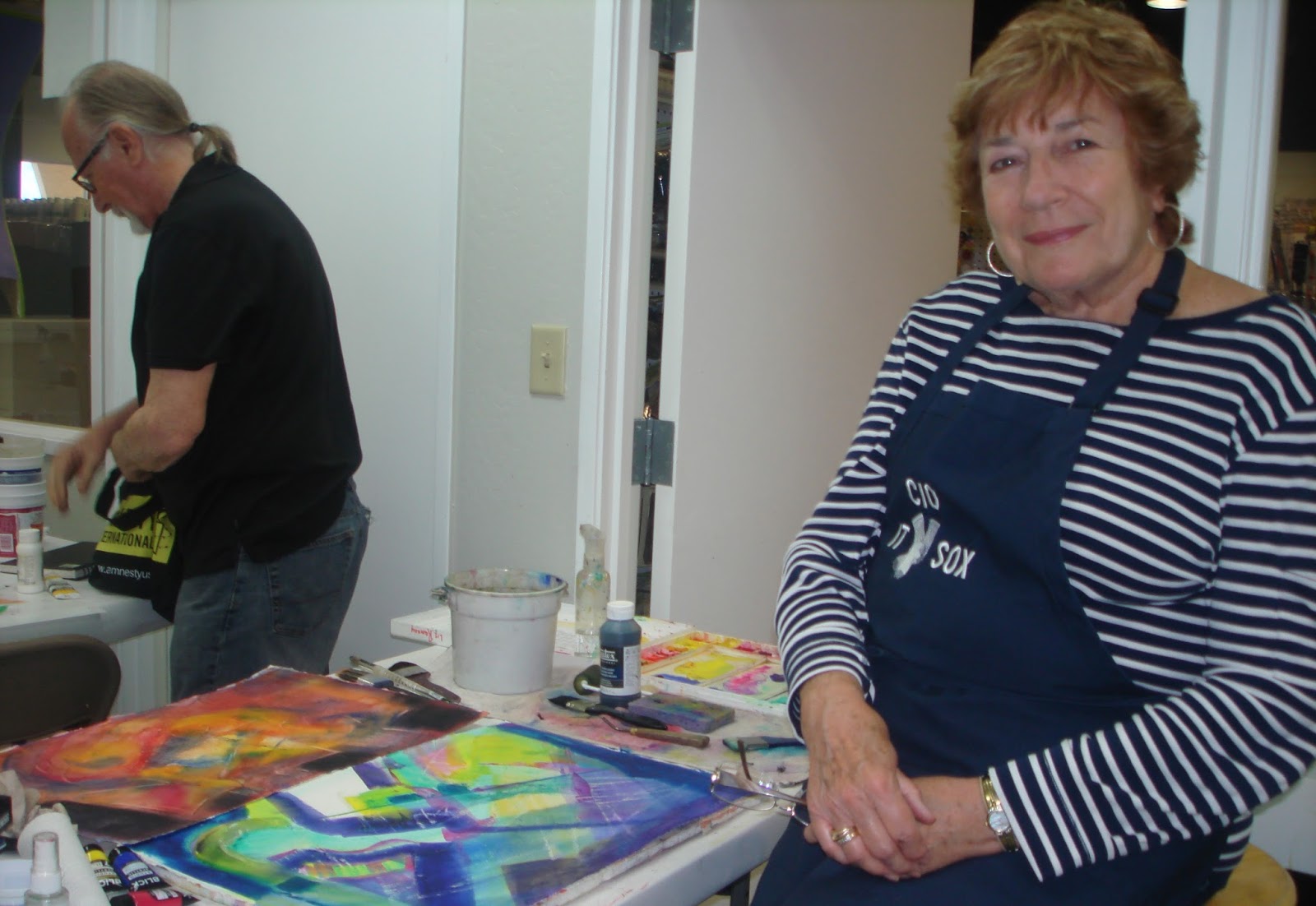
The Intuitive painting class I took last month in Phoenix (see  6/2/15 post,  "Cycles of Creation") produced some interesting moments, resulted in meeting new friends, and captured my 
imagination for what might be possible in the year ahead pursuing a passion for abstract art. I've always learned best by listening and observing. My observations are naturally
very personal and reflect my own esthetic sensibilities, which could very well be
completely different from the artist's own interpretations. But that's what I like about abstract art, there's room for everyone's individual view. The people in my painting class were all teachers in their own way. I'm presenting their paintings today.Thank you everyone!


Melissa (Untitled)


Melissa
     I told Melissa (who by the way was a darling for helping me gather names and emails for this blog project...thank you, Melissa) that her painting reminded me of scenes from my recent trip to Costa Rica. I visited Lankaster Gardens and a small rainforest where the tangled abundance of nature, flowers and animals made a fairly indelible impression. I now tend to see images of colorful birds everywhere I look and could easily pick out a few in her work. I also thought her design was perfect for a fabulous silk scarf or some other killer accessory. I was drooling over her painting and the way it captured a restrained exoticism.


Joyce ("Canyon Ridge")


Joyce
      My photograph of Joyce and her wonderful painting does not do justice to the richness and depth of color and texture in her work. She predominantly used my favorite color (turquoise)  and I was smitten with the intricate layers of color upon color suggesting (to me) caves, caverns and ridges to explore in a midsummer's night dream.It was a painting that called out for many, many minutes of contemplation to explore the rich spaces and places leading to center. And how 'bout those drips? Nice!


Liz ("Hot Music" & "Purple Passion")

  Liz
     I was beset with momentary envy when I saw that Liz had managed to produce not one but two top notch paintings during our class, one warm, one cool. But envy subsided pretty quickly because Liz was way too charming, friendly and talented to be jealous of. I like the way she was able to manipulate shape and design elements while, as the watercolor people always say, 'saving her whites'... that's something I'm working hard on right now. Bravo, Liz!


Sandy ("Open Book")

Sandy
     Sandy's painting showed me how a painting can integrate soft and hard (edges bumped up to gauzy swirls), evoke the whisper of an idea (book), and create interest with one well placed and interestingly shaped swatch of color (ocher, lower left). For me...and this is just my take on it...this is a piece that provides a chance for me to learn by observing, exploring and analyzing the process of how a composition can emerge from a coherent inner vision. In other words, I love the sense of boundaried movement as well as the colors/white space in the piece.


Louis ("Fire And Ice")


 Louis
     Full disclosure here: Louis is my charming and talented husband who loves abstract art and has produced many  amazing pieces which grace our walls at home. He told me he really liked Stan's class  and though he wasn't sure what he was getting into, he ended up liking his painting a lot. Me too. I told him I saw a Georgia O'Keeffe influence, somebody else saw a volcano erupting. Interesting what we see as a result of our own unique experience and perspective. When we got home Louis got inspired all over again with Stan's other technique of 'doodling' pen and ink sketches into a small portable journal. Now Louis is looking at some of the Cubist painters as inspiration  for his daily journal keeping process.


Valerie (Untitled)


Valerie
     Valerie and I laughed when we realized the shot I took of her and her painting reflected almost perfectly Stan's style of painting 'head and torso' (take a look at his website and you'll see what I mean). Her painting was a complete delight to behold because it gave me another way to explore subjects like boundary versus infinity, color blocs, non-traditional focal points, opportunities with white gesso, creating fuzzy edges and more. For me, it evokes a sense of the sky opening up to a stained glass day of beauty and goodness...something about the perceived slants of light from top left, down. The sense of  'salvation' in this work  makes me feel really good...and isn't that what it all comes down to anyway, that old saw:  "I may not know much about art, but I know what I like?"
Suzanne


  Suzanne  (Untitled)

Suzanne was fearless, changing her painting at least three times during the course of the class, which lasted all day. I learned a lot by watching her obliterate a swath of purple, replacing it with a completely different hue that gave a whole different feel to the piece. I thought the Zentangle touch at the bottom of the painting was the piece de resistance, a great addition that provided interesting  and welcome contrast, giving perfect weight to the abstract top third of the piece. 

  
Me

Hmmmmmmm, where shall I begin? My painting started out as a John Marin abstract-inspired piece (see center focal point, the remnants of a pretty nice little forest scene), and ended up as a practice sheet for various techniques suggested by Stan. For example, the gray portions are where I tried out how he uses a special gray gesso he concocts. Ditto the black space. OK, tried it and think I need lots of practice going forward. Think I'll use less next time. Side element is pure black gesso, scrubbed with a large dry brush, then scraped with one of those copper brillo pad things from the kitchen. These machinations produced some interesting texture, with bits of my original forest peeking through. I keep thinking of the long pink and gray swath on the left side as some kind of floaty curtain effect. But then what do I know...in the end it could turn out to be just fruit juice dripping from the raspberry bushes hidden by a rectangular black cloud which is in reality only my black visor hat turned on its side. Ha! 

("On The Side" )


      Well, clearly this painting is one of those 'stay tuned' compositions which will turn into something one of these days that makes sense to me esthetically and emotionally, just not quite there yet.  Working on how to save the red and pink and green flower thing, lower right... this exercise in the imaginative recycling of a creation may turn out to be more fun than doing the original. In the next few weeks I'll revisit this, after I've finished another upcoming abstract workshop at the Sedona Arts Center.   


 Stan Kurth
      To our teacher, Stan Kurth  (stan.kurth@gmail.com),  I say thanks a million for the affordable, inviting and provocative painting workshop. Sharing his captivating approach to intuitive painting through informal conversation throughout the day and an after class analysis was entertaining, instructive and appreciated. Learning about his sketch journaling process was unexpected and very welcome information, something that's given me a whole new perspective on combining words and image. Love having this image of his painting to examine and learn from over the coming weeks.


Tuesday, June 2, 2015

Cycles Of Creation


 Stay hungry, stay foolish
--Steve Jobs, at Stanford University's 2005 graduation


Stan Kurth with his intuitive painting & me
                I heard about an intuitive painting class recently and decided to give it a try. Magic! I traveled downto Phoenix for the class, taught by an intriguing and talented artist named Stan Kurth (stan.kurth@gmail.com).  I learned a lot and  met some great people (whose fabulous paintings I'll share with you next week). After the daylong workshop, I was reminded of something Steve Jobs said about living the creative life. "Stay hungry, stay foolish," which I think is good advice not only for recent college graduates but for people like you and me, people looking to find ways to have a life more creative, alive and awake. It's at wisdom's edge, that nether place of eternal vigilance where the awakened people live (people like intuitive painters) and meet their muse. We're still hungry for creativity and foolish enough to go after it no matter what other people think.


The Creative Life
        Stan asked us to watch him as he dabbed helter skelter with a wax marker on a piece of heavy watercolor paper. He 'doodled' a bit, then with a house painter brush, he began splashing some watercolor paint hither and yon. Slap, dash, swoop, swirl. It looked pretty good by the time he decided to begin adding acrylic paint, after a suitable interlude to let the watercolor dry. He mixed sienna and ultramarine blue (hope I'm remembering this right) to come up with his special gray gesso which allowed him to create gauzy, evocative spaces in among the brighter primary areas he'd already laid down. He gave it a rest and I then set about trying to create my own version of what he'd done. I begin to feel a little frozen as I slogged through the sequential phases of laying down paint, apprehensive as I surveyed my work, evaluating and judging as I went along. Oh phooey, I thought, I'm making a mess. And I was. But it was a kind of divine mess that in the end gave me so much insight into myself and my creative process that it turned out to be a spectacular learning experience of how stark hunger and regal foolishness can take you a very long way towards wisdom's edge. What sort of person ("at my age?", I primly asked myself) does stuff like this? I do, I answered, I do this and gave a rousing Bronx cheer to myself.  

The beginning of The Enchanted Forest...
Frankly, I just can't bear the stifled ordinariness of a life in the safe middle of it all--protected, shielded, cosseted. I tried that and eventually started to lose that crucial understanding of why I was set here on earth in the first place. Namely, to give voice to the ineffable, to see through the obscurity, to contribute my small or large portion of enlightenment to help bring the world into balance. 
 Stan told me to live with the painting I'd started, watch it, listen to it over time and see what comes up. He didn't say it this way, but what he meant, I think, is to let that little seed I'd planted have some time to germinate, let it emerge through a cycle of creation as I tend to it with a little faith, respect and devotion. And then see what happens.


The evolution of The Enchanted Forest....


          This intuitive painting workshop reminded me again that to not trust in the cycles of creation, to remain cloaked in a secure center, shielded from a yearning hunger for truth and the sacred foolishness that hovers just this side of wisdom, is a deadly way of life. That's all there is to it. The fat, soft and mushy middle tempts everyone to cling to the status quo, hiding treasured beliefs while denying our extraordinary perceptions. If your path is that of the creative spirit then get ready to camp out just far enough on the edge of it all so that you can stay hungry and insist on foolishness. Know yourself as that intrepid  observer, that wise fool who can't and won't ever betray the sacred trust for which you came into this often odd and sometimes silly but always interesting world. Here's something to help you hoist yourself out of the safe middle if you find yourself sinking in. Maybe it will boost you up so you can set yourself squarely on a new cycle of creation. Throw yourself heart and soul into trying this one thing and I can make you a promise that you will never, ever see the world the same again.
                                                                                          
       Meet Your Muse
Write about a place you’ve never been but heard about, a place you’ve seen pictures of, tasted the food, explored the culture, experienced the music, and especially, the people you've observed. Finish the story below by writing from the perspective of edge, from the perspective of one who is beginning to live awakened, aware, alive: “I saw them through the fence, the ones who shone with the ignorant bliss of children who remain outside the cocoon of the ordinary stream of life. They called me to join. I was afraid to succumb to temptation. The people of Edgeville were carefree, singing, dancing, feasting, frolicking and worst of all, coloring outside the lines! Well, I said all prissy and pursed, they just better watch out because tomorrow it will be a whole new world when they find out. Find out what, I thought, that they are alive and streaming joy? I set down my bags, opened the gate and went in....”

Friday, April 17, 2015

Surrender To Beauty


        Let the beauty we love be what we do.
There are hundreds of ways to kneel and kiss the ground.
                                                      --Rumi, poet


Morning meditation garden

Surrender      
     Every morning I get up, make a coffee, sit down, switch on my electric candle (symbolic, handy, economically sensible and besides I'm Aquarius rising), then deliberately surrender to beauty. Eyes right, a view beyond the small, lace curtained window appears and behold!     Chunky textures and shapes, a pink stone wall, cascading English ivy with deep green leafy variations, an endless expanse of golden sunrise.  Hello out there, you big old beautiful day!


Blue Wind, Tony Abeyta (tonyabeyta.com)
         Sun, lace, rocks, sky, plants? Oh please, I hear you say, this is nothing to get worked up about. No, no I insist, on the contrary, it's everything to get worked up about.  It is in this present moment that I am spoken to about beauty. I am breathing, I am safe, I am grateful and I am blessed. I know how to move into this optimistic and welcoming inner space because I've worked for it. Blood, sweat and tears kind of work (that, of course, is a whole other story and I've written about it elsewhere). Now, it's made easy for me, and I choose these words carefully and use the passive voice for a reason. I no longer try to force anything, an awareness and awakedness that comes in its own way, its own time. My part is to follow the blue winds, listen to the Saguaro cacti, speak to the gnarly old junipers, salute the soul stirring sunsets, marvel at the charming hummingbirds, and honor the magnetic red rocks turned into enchanted cairns living along well used hiking trails.

Hozho      

Surrender, Larry Yazzi

        Here in Arizona, I've become familiar with Hozho, a Navajo Beauty Way concept that means harmony, peace of mind, goodness, ideal family relationships, beauty in arts and crafts, and health of body and spirit. I am reminded of this when I see works like Navajo (Dine') sculptor Larry Yazzie's Surrender. He begins each new piece without knowing what it will turn out to be. He says the stone decides itself what it will be as the piece develops and that he feels like if you ever get to the place where you know what you're going to do then it's "just a job." turqtortsedona.com/Artists/yazzie_larry/index.htm

John Loring
         Maybe Hozho isn't everyone's idea of walking in beauty, but for those who understand the lure of nature and especially the charms of the desert, the mystery, harmony and call of the wild is magnetic and irresistible. Like John Loring, design director emeritus for New York City's world renowned jeweler Tiffany & Co. (www.tiffany.com) who grew up on a ranch in Cave Creek, Arizona. http://sagedillon.wordpress.com/writing-samples/silver-tea/) Now retired and in his seventies, he's said much of the inspiration for his design sensibilities came from the shapes, textures, smells, sounds and tastes of nature he'd experienced during his boyhood years. The above link is an interesting read about Loring's life.


Tiffany Flora & Fauna, edited by John Loring
Focus
            This focus on beauty takes patience and fortunately most of us past 50 have developed some by now. Courage too. I have the deepest admiration for people who fiercely and wholeheartedly devote their lives to the embrace and creation of beauty. The longer I live, the more I hunger for that because life is awash, just drowning in possibilities for walking the Beauty Way, for the sacred experience of Hozho, however you may find it or define it. I see not only the visual as a part of Beauty Way but also the intangible and spiritual: the wish for someone's well being, a sense of gratitude for comfort and safety, gladness for reconnecting with old friends, letting go of an old, tired, ugly thought. Purposely focusing on the present moment as a singular beauty in itself is a way to honor it for what it is now and for what it might become. Just as Larry Yazzi begins work on each new piece not knowing what it will turn out to be, so do I begin each day open to what it may become. I let the day itself decide  for me. My part is to wake up, pay attention and surrender to beauty. Life isn't a job, it's a work of art.

Your Hozho
1)    Describe a moment when you encountered something in nature so beautiful that it brought you close to tears with its near-perfection.  Don't forget the sensual details, sight, sound, taste, feel, smell.
2)    Create a short tribute for an inspirational person you admire (real person or fictional character) who first gave you a sense of beauty and awakened you to the possibility of being so present that life could be experienced on a higher, more creative and fulfilling plane of existence.
3)    Recall and write about a story (could be fiction, non-fiction, poetry, essay) that was so viscerally powerful that, after you’d finished reading it,  your life was changed forever in a positive way.

Friday, April 10, 2015

A Remarkable Meeting


Kituwah
A Remarkable Meeting


        Shortly after arriving in Sedona last year I joined the Sedona Visual Artists' Coalition, a vibrant and inclusive community of creative souls, nice folks, talented artists. The group's annual show in November featured a theme of "Who Am I?" and as you might imagine, there was great creativity and joie de vivre displayed by the artists whose interpretive artworks were shown. One in particular caught my eye and apparently a lot of other eyes too. The People's Choice Award went to  sculptor Tom Gebler for his bronze Kituwah, a Cherokee Native American. And though the sculpture itself is stunning, the really amazing story is why Gebler chose this piece to answer the question "Who Am I?"

 
A Timeless Tale
         I talked to Tom at the show and got the feeling I'd encountered a man on a mission, a sense reinforced when I heard the remarkable story of how this sculpture was created. The prize winning bronze represents Gebler's dogged determination to find the answer to a mystery that has haunted him for years. Tom's story is an inspiring tale of awakening, enlightenment and reparations, a story he describes as a journey to make peace with what he believes is a lost-and-found part of his own personal history as well as a quest to offer insights in to peacemaking among cultures. But the story that you're about to hear is probably not not what you may think.
Kituwah and sculptor Tom Gebler


The Story
          Tom says it all started when he was an art student back in 1981. Sitting in his dorm room one day minding his own business, he experienced an intense visual experience of a Native American man accompanied by a feeling of  visceral 'knowing.' He couldn't describe or explain what it was but the artist in him knew enough to quickly fashion a clay image of the bust of a young Cherokee man who Tom would one day know as Kituwah. Just before completing the piece, he had the compelling feeling that he could no longer work on it. He didn't know why but somehow it felt wrong to touch it. So he put it away and that was the end of it until 1993. He was working on a guided visualization with a healer which turned out to be an experience that provided further revelations for Tom and his relationship with the mysterious Indian he had encountered 12 years before. Tom describes it this way:
         "During that session she asked me to go to a place where I felt safe, I saw and described the apple orchard across the creek from my  (boyhood) cabin. Then she asked me where I felt powerful. In my mind I went from the apple orchard to the nearby rocky wash and described how it felt as I ascended the massive boulders. She then simply asked 'Who is there at the top?'  At that moment I saw the image of this Native American man and said the word 'Kituwah.'"  Tom recognized the image but again didn't follow up with any real intent to connect the dots. It was only when as a middle aged man in his mid-fifties, after he'd returned to live permanently in what had been his boyhood vacation cabin in Sedona's Oak Creek Canyon, that he felt a pull to revisit the other connections made all those years before. His story took a sharp twist when an event involving a potential life and death drama set him on the path he's now following. It turns out that the cliff above Oak Creek Canyon by his cabin  where he'd encountered Kituwah in his long ago guided visualization turned out to be the very same spot where he ended up initiating a rescue for a stranded hiker at serious risk. The grateful hiker later provided financial support for Tom to finish the original clay bust of Kituwah and to cast it in bronze. With the sculpture finished after languishing all those years, Tom began a serious investigation into who and what Kituwah might mean, for him and perhaps for others someday.


Site of Kituwah Mound near Bryson City, North Carolina
 A Sacred Site
        Through research Tom learned of a sacred site, the Kituwah Mound, nestled in the Smoky Mountains of Western North Carolina near a fork in the Tuckasegee river.  At one time the site held a structure which housed the sacred flame of the Cherokee,  kept burning at all times by a specially appointed leader who lived there. This flame was very much symbolic of the life of the Cherokee, and people from nearby villages routinely visited to light ceremonial fires with it. Today the site is seen as a reminder of unity amongst the Cherokee People. Ceremonies are being conducted at the mound, people are returning to pray and reconnect with their roots even as a debate rages about whether the site should be developed. Some say yes, while traditionalists say the site is off limits. The remainder of the mound is about nine miles from the Eastern Cherokee reservation, once as large as 36,000, now a population of around 12,000. The Kituwah site was almost  completely destroyed during the carnage wrought by Griffith Rutherford, a militia General who led an expedition against the Cherokee in 1776 at Kituwah Mound. The twist in this story is that Tom's personal ancestral lineage research uncovered the fact that he was related not to the Cherokee nation, but to General Rutherford himself. The knowledge that he was the eighth generation removed from the man who'd perpetrated a genocidal crime, shocked and bewildered him and made it even more difficult for him to let go of the story. What he chose to do was remarkable.

Lessons Learned
Cherokee Peace Flag
       Last year Tom bundled up a new casting of his sculpture and set off to meet with Cherokee leaders in North Carolina. He says he saw it as a way to offer what might be seen as reparations, apologies, amends. He presented his story along with his sculpture Kituwah to Cherokee leaders who politely accepted but told Tom that in Cherokee tradition "I'm sorry" was not the accepted protocol. Better to simply say "This is what happened and here is what I have learned." A rather humbling experience, one that's brought him full circle. What happens now, I asked Tom. He said he doesn't know, that he's not attached to whatever the outcome may be to the story of Kituwah, but he hopes his story will somehow bring inspiration to others learning to make peace.  

 Signs & Symbols
          Tom's travels with Kituwah reflect his growing belief that spiritual seekers have an expanded field of opportunities open to them if they can cultivate the detachment necessary for paying true attention to the signs, symbols, messages and wonders that are out there for everyone, available for discovery everywhere. "We simply have to learn to be open enough and clear enough and able to pay attention to and receive the lessons life brings, and then let go of any expectations around those lessons,' Tom says. "These are the two key things I've learned from this experience with Kituwah." Tom's put together a youtube video to help make sense of his journey...I think it's worth watching: (www.youtube.com/watch?v=Xx3gH1rl-Ak)